
Emergency Roof Repair Near Me: What Rialto Homeowners Should Do First
In an active roof breach during rain, moving furniture is more valuable than going on the roof. Calling a contractor before you’ve done three specific things wastes time the weather won’t give back. Here’s the sequence that protects your Rialto home: control the water inside first, document everything for insurance, then address the exterior. If you’d rather skip the details and get someone out now, call (877) 588-7942.
Most Rialto homeowners do this backwards. We get calls from people who’ve spent 45 minutes with a tarp on a ladder in 30 mph gusts while their living room ceiling sags with thirty gallons of rainwater. The roof can wait. The Sheetrock, insulation, hardwood, and wiring below it cannot. We’ll walk through exactly what to do in the first 90 minutes, what actually matters for the insurance claim, and how to tell if the crew you hired did the temporary fix correctly.
The First 90 Minutes: Interior Water Control Comes Before Everything Else
When water comes through a roof in Rialto, your ceiling is a sponge with a drywall membrane. It holds until it can’t. Then it dumps. That gravity-fed release is what destroys furniture, floors, and anything electrical below. Your first job is to intercept that water before it lands on something expensive.
Move furniture and electronics out of the drip zone immediately. If you can’t move a sofa, get a trash bag over it and shove towels under the legs. Then punch a small drain hole in the sagging part of the ceiling using a screwdriver or a pencil. That feels wrong to most people, but the alternative is a ceiling collapse that takes out your drywall, insulation, and whatever was underneath the bulge. Put a bucket under the hole. A five-gallon bucket fills faster than you think, so swap it often and keep one spare nearby.
After the active flow is controlled, turn on a box fan or any fan you have pointed at the wet area. Mildew starts in 24 to 48 hours in Rialto’s climate, and it starts in the dark, warm space between your ceiling and roof deck. The fan buys you time.
Only after the interior water is managed should you think about the roof surface itself. Going up a ladder in the rain, on a slick Rialto concrete tile or steep pitch, before you’ve handled what’s happening inside the house, is how people end up with a broken leg and a flooded living room.
Documentation Before Mitigation: What San Bernardino County Insurers Actually Require
The documentation sequence matters more than most homeowners realize. Insurance adjusters in San Bernardino County look for photographic evidence taken before anything gets moved, tarped, or repaired. Once you shift the wet couch or pull down the damaged drywall, the adjuster has to take your word for it. Don’t make them.
Here’s the photo sequence that has made the difference for Rialto homeowners we’ve worked with on storm claims:
- Wide shots first. Stand back and photograph the entire room showing water, damage, and surroundings. These establish context.
- Close-ups second. Get within two feet of the water stain on the ceiling, the wet drywall, the damaged insulation.
- The source third. Photograph the roof area from inside the attic if you can see daylight or water penetration.
- Contents fourth. Photograph every damaged item: furniture, electronics, rugs, clothing. Document brand names and model numbers where visible.
- Exterior fifth. Only now photograph the roof from the ground. Wind-driven rain damage, lifted shingles or tiles, displaced flashing.
Log the date and time of each photo, and keep all receipts for any emergency supplies you buy, from tarps to buckets to fans. Your carrier will reimburse reasonable expenses. The more disciplined you are in the first hour, the smoother the claim goes.
One more note on documentation: if you can see water actively entering the attic, go up there with a flashlight and photograph it before anyone touches anything. Attic photos showing active intrusion are the strongest evidence you can give an adjuster.
Rialto Wind and Temporary Tarping: What a Real Fix Looks Like
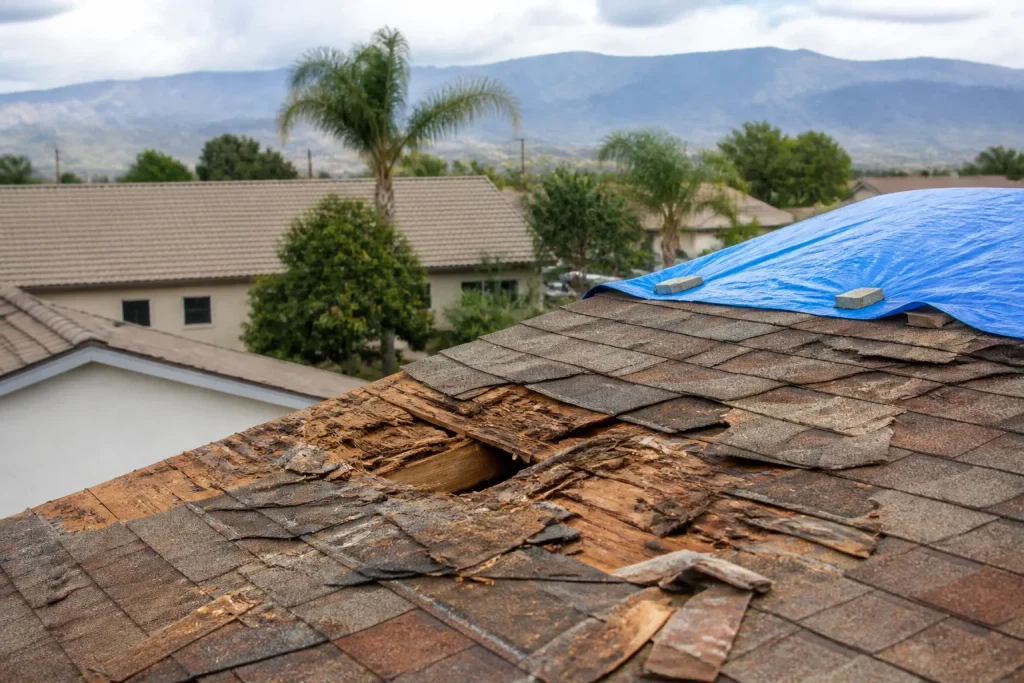
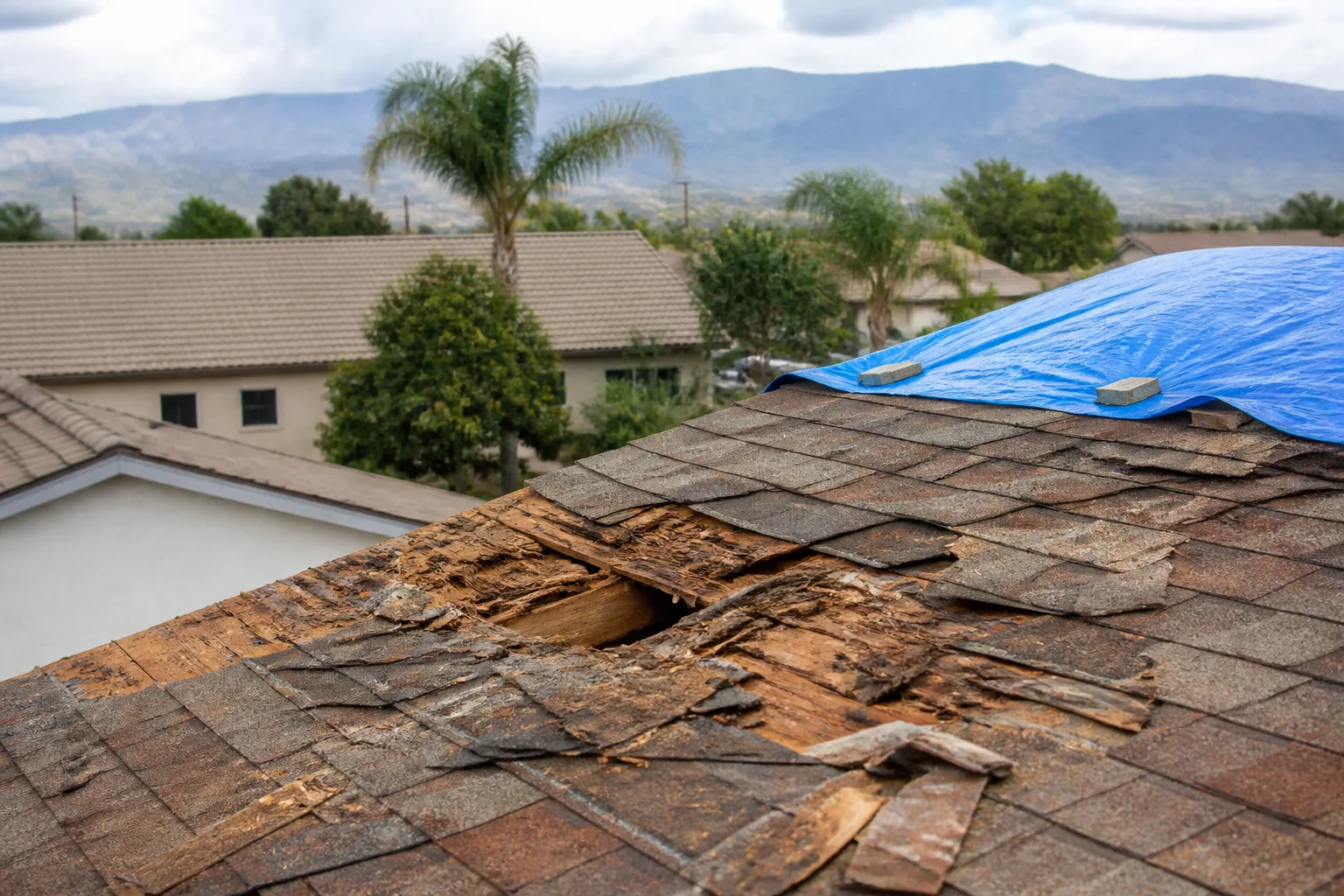
Rialto sits in a wind corridor where Santa Ana conditions can push 40 to 50 mph gusts through the foothills. A tarp that survives a mild coastal rain will shred in a Rialto wind event if it’s not anchored correctly. Here’s what we inspect when we arrive after another crew did a temporary tarp.
A rushed tarp job looks like this: the tarp is draped loosely over the damaged area, held by a few nails or sandbags, and flapping at the edges. Wind gets under a loose tarp and turns it into a sail. Within hours, it lifts, tears, or slides off entirely. We’ve seen more water damage from failed temporary tarps in Rialto than from the original roof breaches.
A proper temporary tarp in Rialto wind conditions involves:
- Furring strips or sandbag anchors every 12 to 18 inches, not just at the corners
- Tarp extended at least 4 feet past the damaged area in every direction
- Edges wrapped and secured so wind cannot get underneath
- Calking or sealing at the tarp’s leading edge against wind-driven rain
- No exposed nail heads penetrating the undamaged roof surface wherever avoidable
If the crew that shows up doesn’t take at least 20 to 30 minutes to secure the tarp, they’re not doing it right. A wind-rated temporary cover buys you the time to get a proper repair or replacement scheduled without the roof leaking again in three days.
Evaluating an Emergency Quote on the Spot: Fair Premium vs. Price Gouging
Emergency roofing work runs more expensive. That’s legitimate. You’re paying for a crew to drop what they’re doing, come out in dangerous weather or immediately after it, and work in conditions that are slower and riskier. In Rialto, a fair emergency premium can run 20 to 35 percent above standard rate. That range accounts for after-hours labor, mobilization, and the reality that emergency work is often done alongside other calls from the same storm.
What’s not legitimate:
- A quote that doubles or triples the standard rate for the same repair.
- A contractor who refuses to itemize the quote or explain the premium.
- Pressure tactics like “sign now or I’m gone in an hour, and the tarp won’t last the night.”
- Demands for full payment upfront before any work is done.
- Any crew that shows up unlicensed or cannot produce proof of insurance when asked.
If you’re standing in a rain-soaked hallway with a crew telling you it’s $3,800 to tarp a 10-by-10 section of roof, that’s a signal to get a second opinion. But here’s the nuance: if the crew shows up at 2 a.m. in a storm with wind gusts, wet ladders, and a real risk of someone getting hurt, the premium is not just fair, it’s earned. We specialize in roofing in Rialto, and we’ve told homeowners to call someone else when our own availability was days out and the home was actively flooding. The honest answer is sometimes, “you need whoever can get there fastest.”
Repair or Replace: On-the-Spot Indicators That Separate a Patch From a Money Pit
Not every roof breach is a repair situation. Rialto roofs face a specific set of stressors: high UV exposure, seasonal Santa Ana winds, and a dry climate that bakes and cracks materials over time. When water finds its way through, the question is whether you’re looking at isolated damage or the leading edge of systemic failure.
Indicators the breach is isolated and a repair makes sense:
- The damage is tied to a single recent event, like a fallen branch or a lifted shingle from last night’s wind
- The surrounding roofing material is solid, with no granule loss, curling, or cracking
- You can see the point of entry, and the roof deck below is not soft or delaminating
- Flashings, boots, and valleys outside the damage area are in good shape
Indicators the breach is a symptom of broader failure:
- Granule loss in your gutters or at downspout outlets that predates this storm
- Curling or lifting shingles in multiple areas away from the leak
- Soft spots in the roof deck when walked or probed
- Recurring leaks in the same general area across multiple storms, even after prior patches
In our experience, if you’re on a second or third patch in the same area within a couple of years, the roof is telling you something. Spending $700 to $900 per patch every year on a roof that’s reaching the end of its service life is just paying for the replacement in installments, plus the cost of drywall repair each time. A roof inspection that produces an honest, structured assessment will tell you which side of the line you’re on. If you’re in Rialto and want a straight answer before deciding, we do roof inspections as a standalone service, not as a sales pitch. The number to call is (877) 588-7942.
What to Do While You Wait for the Roofing Crew
If you’ve got water controlled inside, documentation done, and a crew scheduled, there are a few more things that make a difference in Rialto specifically. First, clear a path to the attic access point, and move anything in the attic away from the wet zone. Wet insulation holds water against the roof deck and accelerates rot. If you can safely remove soaked insulation, bag it and get it out. Don’t touch it if it’s in contact with any wiring. Second, if you have a tile roof, check the ground near your downspouts for broken tile pieces. A single cracked tile can channel water under adjacent tiles and create a larger leak than the crack itself suggests. Third, note which direction the wind was blowing during the storm. That tells the roofing crew where to look for lifted edges and wind-driven rain entry points that aren’t obvious from the ground.
When to call a pro: if you see active water intrusion, if the sag in your ceiling is more than a few inches, if you have any doubt about the structural safety of walking the roof, or if this is the second time this area has leaked, call (877) 588-7942. We only do roofing, which means we don’t have a siding crew waiting on us to finish so we can get to your roof. It’s roofing, start to finish.
The Bottom Line
The 90 minutes after a Rialto roof breach determine whether you’re dealing with a roofing repair or a full interior restoration. Control the water inside first. Document everything before you move anything. Then get a proper temporary cover in place that can handle Rialto’s wind conditions. If the damage is isolated, a repair makes sense. If the roof has been telling you it’s tired for years, don’t throw money at patches that fail. If you’re in Rialto and need someone to assess the situation honestly, Ridgeway Roof Repair offers free estimates. Call (877) 588-7942, and we’ll help you figure out what you’re dealing with before you commit to anything.
Related services in Rialto: Roof Repair in San Bernardino, Roof Inspection in San Bernardino, and Roof Replacement in San Bernardino. From Ridgeway Roof Repair home, you can reach all three.
Frequently Asked Questions
Emergency roof repair in Rialto typically runs $450 to $1,400 for temporary tarping and water mitigation, and $600 to $1,800 for permanent repairs once the weather clears. The emergency premium is usually 20 to 35 percent above standard rates, reflecting after-hours labor and faster mobilization. If you’re quoted double or triple the standard rate, get a second opinion before signing. For an exact quote on your situation, call (877) 588-7942. Estimates are free.
No. Going on a wet roof in Rialto wind conditions is dangerous, and an improperly secured tarp will likely fail before the storm ends. Your first job is interior water control. If you can safely place a tarp over the area from inside the attic, that can help, but exterior roof work in active rain should be left to a trained professional. Call (877) 588-7942 and we’ll talk through what’s safe to do right now.
Most homeowners policies in San Bernardino County cover storm-related roof damage, including the cost of temporary tarping and water mitigation. The key is documentation: photograph everything before you move or repair anything, keep receipts, and report the claim promptly. Sudden damage from wind or falling debris is typically covered. Long-term wear or neglect is not. We can’t speak for your specific policy, but we’ve helped many Rialto homeowners structure their documentation to support a claim.
Response time depends on demand. After a major storm, every roofing company in Rialto is fielding calls simultaneously, and honest contractors will tell you if they’re a day out when someone else can get there in two hours. If your home is actively flooding, your best move is to call multiple companies and take whoever can get tarp on the fastest. If you call us, we’ll be straight with you about our availability. The number is (877) 588-7942.
Written by the team at Ridgeway Roof Repair, serving Rialto since 2018.
Need Roofing Help?
Call Ridgeway Roof Repair — licensed & insured, here with fast after-hours help in San Bernardino.
(877) 588-7942